 +86-13646196162
 info@hysonindustry.com




 русский
  عربى
عربى 


How to Calculate Circular Column Formwork: Step-by-Step Guide
 2026.07.31
Content
- 1 Calculating Circular Column Formwork Comes Down to Two Formulas: Concrete Volume and Contact Surface Area
- 2 Step 1: Calculate the Concrete Volume Needed
- 3 Step 2: Calculate the Circular Column Formwork Contact Area
- 4 Worked Example: Sizing Formwork for a Bridge Pier Column
- 5 Accounting for Lateral Concrete Pressure
- 6 Practical Factors That Affect Real-World Formwork Sizing
- 7 Common Applications for Circular Column Formwork
- 8 Summary: A Reliable Formula-Based Approach to Circular Column Formwork
Calculating Circular Column Formwork Comes Down to Two Formulas: Concrete Volume and Contact Surface Area
To calculate circular column formwork, you need two numbers: the volume of concrete the column will hold, calculated as πr²h, and the contact surface area of the formwork itself, calculated as πDh, where D is the column diameter and h is the column height. These two figures determine how much concrete to order and how large a panel system to specify when sourcing steel formwork for round columns. Getting both calculations right the first time avoids costly reordering mid-pour and ensures the formwork panels selected can actually withstand the lateral pressure the wet concrete will exert. The remainder of this guide walks through each formula step by step, with a worked example, and explains the additional factors that affect real-world formwork sizing on a job site.
Step 1: Calculate the Concrete Volume Needed
Before sizing the formwork itself, you need to know how much concrete the circular column will require, since this figure also informs the pressure calculations used later in formwork design.
The Volume Formula
The volume of a cylindrical column is calculated as V = πr²h, where r is the column radius, h is the column height, and π is approximately 3.14159. For a column with a diameter of 0.8 meters and a height of 3 meters, the radius is 0.4 meters, giving a volume of 3.14159 × 0.4² × 3, which equals approximately 1.51 cubic meters of concrete.
Adjusting for Waste and Overpour
Most estimators add a waste allowance of 5 to 10 percent to the calculated volume to account for spillage, minor formwork deflection, and uneven ground contact at the column base, so a 1.51 cubic meter theoretical volume is often ordered as roughly 1.6 to 1.66 cubic meters in practice.
Step 2: Calculate the Circular Column Formwork Contact Area
Once the concrete volume is known, the next step is calculating how much formwork surface area is needed to contain that concrete during the pour and curing process.
The Surface Area Formula
The formwork contact area for a circular column is calculated as A = πDh, where D is the column diameter and h is the column height. Using the same example of a 0.8 meter diameter column at 3 meters tall, the formwork area equals 3.14159 × 0.8 × 3, which comes to approximately 7.54 square meters of contact surface.
Why This Number Matters for Ordering
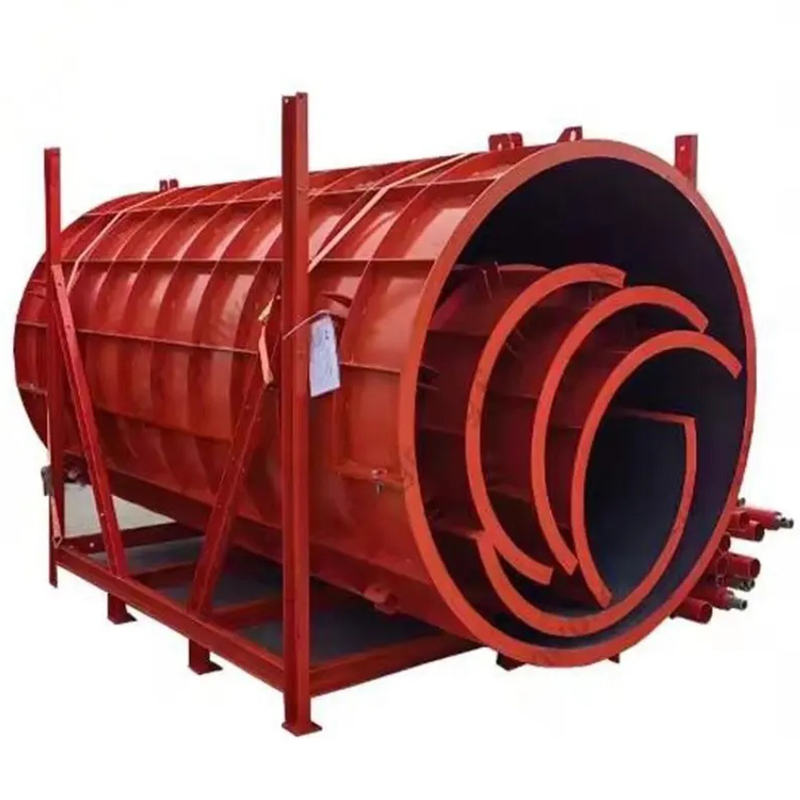
Circular column formwork panels are typically supplied as curved steel or fiberglass sections in standard heights, so knowing the total contact area lets a contractor determine how many panel segments, tie rods, and clamping sets are required to fully enclose the column at the specified diameter.
Worked Example: Sizing Formwork for a Bridge Pier Column
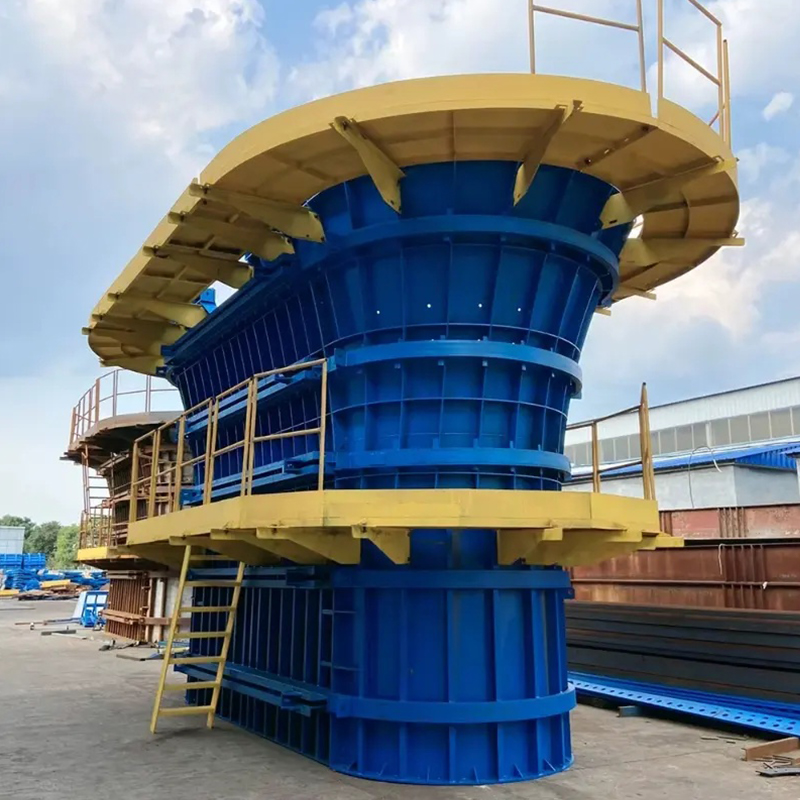
To make the calculation concrete, consider a bridge pier column specified at 1.2 meters in diameter and 5 meters in height, a common size range for infrastructure projects using round column formwork.
With these figures, a contractor knows the formwork system must enclose a 3.77 meter circumference and provide roughly 18.85 square meters of contact area, which is the basis for selecting the number of curved panel sections and their vertical height increments.
Accounting for Lateral Concrete Pressure
Surface area alone does not fully specify the formwork system, because wet concrete exerts significant lateral pressure against the panel walls before curing, and this pressure determines the required panel thickness and tie rod spacing.
- Lateral pressure increases with pour height, pour rate, concrete temperature, and mix design, and is typically calculated using standard concrete formwork pressure formulas referenced in national concrete construction codes.
- Faster pour rates and taller single-lift pours generate higher peak pressure, which is why many circular column formwork systems specify a maximum recommended pour rate per hour.
- Panel thickness and tie rod or clamp spacing are then selected to keep deflection within acceptable limits, typically a small fraction of the panel span, to maintain a smooth, uniform column surface after stripping.
Practical Factors That Affect Real-World Formwork Sizing
Beyond the core volume and area calculations, several practical details commonly influence how circular column formwork is specified and ordered on an actual project.
Standard Diameter Increments
Steel circular column formwork is commonly manufactured in fixed diameter increments, often in 5 centimeter steps across a range from roughly 25 centimeters up to 1.2 meters or more, so project diameters are frequently rounded to the nearest available standard size rather than custom-fabricated for every project.
Panel Height and Number of Lifts
Tall columns are often poured in multiple lifts using stackable formwork sections in 1, 1.5, 2, or 3 meter height increments, and the total formwork order needs to account for how many vertical sections are required to reach the full column height plus any working platform allowance.
Reuse Cycles
Because steel formwork panels can typically be reused across dozens of pours, projects with multiple identical columns often calculate formwork quantity based on the number of columns being poured simultaneously rather than the total number of columns in the project, cycling the same panels through sequential pours to reduce material cost.
Common Applications for Circular Column Formwork
Understanding where round column formwork is typically applied helps clarify why accurate volume and area calculations matter so much at the planning stage.
- Bridge piers and highway overpass supports, where consistent column diameter and a smooth finished surface are structural and aesthetic priorities.
- High-rise building cores and support columns, where repeated identical pours benefit from reusable steel panel systems.
- Municipal infrastructure such as water treatment facilities and tunnel construction, where round formwork accommodates cylindrical structural elements.
- Sports complexes, stations, and airport buildings, where exposed circular columns are often a visible architectural feature requiring a clean concrete finish.
Summary: A Reliable Formula-Based Approach to Circular Column Formwork
In summary, calculating circular column formwork requirements starts with two straightforward formulas: concrete volume using πr²h and formwork contact area using πDh. From there, factoring in lateral concrete pressure, standard panel diameter increments, and the number of pour lifts translates the raw math into an accurate material order.
When sourcing a steel formwork supplier for round column projects, confirming available diameter increments, panel height options, and documented load-bearing capacity gives a more accurate basis for planning than relying on volume calculations alone, since the physical formwork system must be matched to both the concrete quantity and the pressure it will need to withstand during the pour.


- Location
- Group 3, Fangzhuang Village, Rucheng Subdistrict, Rugao City, Nantong, Jiangsu, China
- Follow us
- Phone
- +86-13646196162
- info@hysonindustry.com
