 +86-13646196162
 info@hysonindustry.com




 русский
  عربى
عربى 


What Are the 4 Types of Scaffolding?
 2026.06.22
Content
- 1 The 4 Types of Scaffolding: A Direct Answer
- 2 Type 1: Tube and Coupler Scaffolding
- 3 Type 2: Frame Scaffolding (H-Frame Scaffold)
- 4 Type 3: System (Modular) Scaffolding
- 5 Type 4: Suspended Scaffolding
- 6 Comparison of the 4 Scaffold Types
- 7 Ringlock vs. Cuplock vs. Kwikstage: Detailed System Scaffold Comparison
- 8 Key Scaffold Components Every Buyer Should Know
- 9 How to Choose the Right Scaffold Type for Your Project
- 10 Scaffold Safety Standards and Quality Certification
The 4 Types of Scaffolding: A Direct Answer
The 4 main types of scaffolding used in modern construction are: tube and coupler scaffolding, frame scaffolding, system (modular) scaffolding, and suspended scaffolding. Within system scaffolding — the dominant scaffold type for mid-to-large construction projects today — the three most widely used sub-systems are ringlock, cuplock, and kwikstage. Understanding each scaffold type's design, load capacity, and ideal application helps project managers, contractors, and procurement teams select the right system for every job site condition.
This guide covers all four scaffold types in depth, compares their key performance characteristics, and outlines the practical factors that determine the best choice for industrial, commercial, and infrastructure projects.
Type 1: Tube and Coupler Scaffolding
Tube and coupler scaffolding is the oldest and most versatile scaffold system still in widespread use. It is built entirely from individual steel tubes (standards, ledgers, and transoms) connected by drop-forged or pressed-steel couplers (also called clamps). Because there are no pre-defined connection points, tube and coupler scaffold can be configured to fit virtually any structure geometry — curved facades, irregular plans, and complex industrial equipment.
Key Components
- Standards: Vertical tubes that transfer all loads to the ground through base plates.
- Ledgers: Horizontal tubes running parallel to the building face, connecting standards at each lift level.
- Transoms: Horizontal tubes running perpendicular to the ledgers, supporting scaffold boards or planks.
- Couplers: Right-angle couplers, swivel couplers, and sleeve couplers that join tubes at any required angle or position along the tube length.
- Diagonal braces: Tubes fixed with swivel couplers at any angle to stabilize the scaffold against lateral loads.
Where Tube and Coupler Scaffold Excels
Tube and coupler scaffold is the preferred choice for irregular or heritage structures where no two bays are the same size, for scaffolding around complex industrial equipment such as process vessels and pipe racks, and for shipyard and offshore applications where the geometry of the structure being accessed changes continuously. Its complete geometric freedom comes at a cost: erection is slower and more labor-intensive than modular scaffold systems, and the quality of the erected scaffold depends heavily on the skill of the scaffolders placing the couplers.
Type 2: Frame Scaffolding (H-Frame Scaffold)
Frame scaffolding — also called H-frame scaffold or mason scaffold — is built from pre-welded steel frames that are stacked vertically and connected horizontally by cross braces and platform units. Each frame is a rigid welded assembly, typically in a walk-through or ladder configuration, produced to standard heights and widths.
Standard Frame Configurations
- Walk-through frames: An open rectangular frame with a clear opening at the bottom, allowing workers to pass through at ground level without ducking. Common in exterior masonry and plastering work.
- Ladder frames: A frame with a fixed ladder integrated into the vertical standard, providing worker access between levels without a separate stair tower.
- Heavy-duty hi-load frames: Manufactured from larger-diameter tube (OD 57 mm or 60 mm) for high vertical load applications such as shoring and falsework.
Advantages and Limitations
Frame scaffold is fast to erect on simple, rectangular projects because the pre-welded frame eliminates the need to assemble individual components at each node. It is widely used in residential construction, commercial exterior work, and interior drywall operations. Leveling jacks at the base and locking casters on rolling frame scaffold towers allow it to adapt to slightly uneven surfaces.
The main limitation of frame scaffold is its fixed geometry. Standard frame widths and heights cannot be changed on site, which makes it unsuitable for complex structural shapes or projects requiring non-standard bay widths. It also lacks the multi-directional bracing capability of modular scaffold systems, limiting its use at very great heights or under heavy shoring loads.
Surface treatment for frame scaffold typically involves hot-dip galvanizing, pre-galvanizing, or powder coating. Powder-coated frames can be supplied in custom colors to meet project or client requirements — a practical option for high-visibility or branded construction sites.
Type 3: System (Modular) Scaffolding
System scaffolding — also called modular scaffolding — uses prefabricated components with fixed-dimension connection points, replacing the infinite adjustability of tube and coupler with a standardized set of standards, ledgers, braces, base jacks, and platform units that connect rapidly at pre-defined node intervals. System scaffold is now the dominant scaffold type for medium and large construction, industrial maintenance, and infrastructure projects worldwide because it combines the speed of frame scaffold with far greater flexibility in geometry and load capacity.
The three most widely used system scaffold sub-types are ringlock, cuplock, and kwikstage. Each has a distinct connection mechanism, load profile, and regional market preference.
Ringlock Scaffolding
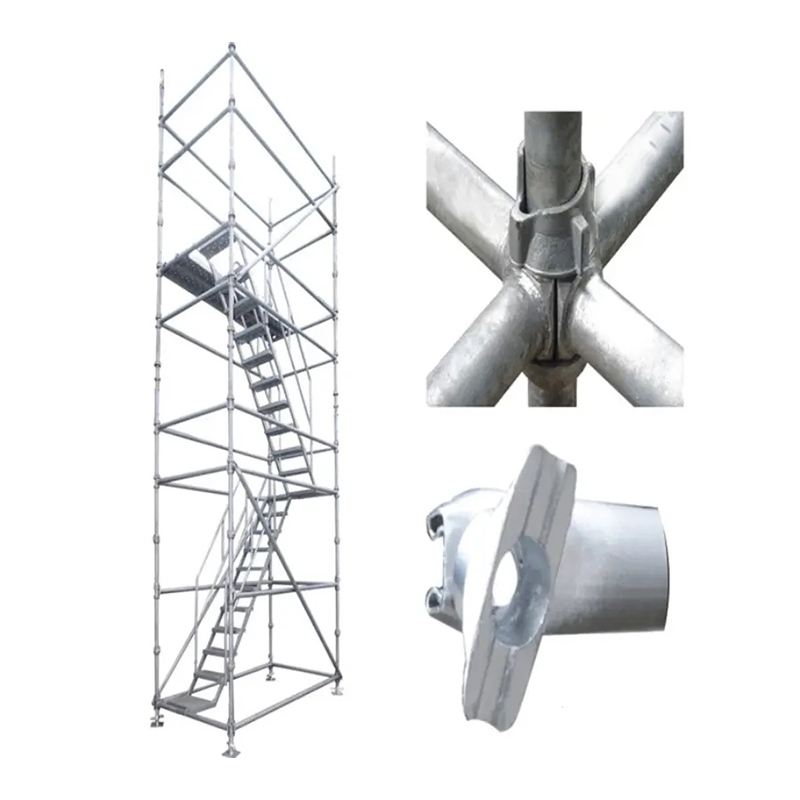
Ringlock scaffold — also known as rosette scaffold or pin-lock scaffold — uses vertical standards with circular rosette plates welded at regular intervals (typically every 500 mm). Each rosette has 8 punched slots into which the wedge heads of ledgers, transoms, and diagonal braces can be inserted and locked with a single hammer blow. This 8-direction connection capability makes ringlock the most geometrically flexible of the modular scaffold systems.
- The centralized load path through the rosette node minimizes eccentric stress and delivers superior torsional rigidity compared to cup-type systems.
- The W60 heavy-duty ringlock system can achieve a maximum load capacity of 80 kN per single leg, making it suitable for bridge falsework, highway shoring, and heavy industrial support structures.
- Ringlock scaffold is the preferred system for complex industrial sites including refineries, shipyards, power plants, and offshore platforms, where the scaffold must adapt to curved equipment, multi-level pipe racks, and non-rectangular plan geometries.
- Material: high-strength steel tube, OD 48.3 mm (standard) or OD 60 mm (heavy-duty), typically hot-dip galvanized for corrosion protection.
Cuplock Scaffolding
Cuplock scaffold was developed in the 1950s as one of the first modular systems to replace traditional tube and coupler on repetitive, rectangular projects. Its distinctive feature is a cup-joint locking mechanism: each node point on the vertical standard has a lower fixed cup and an upper sliding cup. The T-shaped hooks of up to 4 ledgers or transoms are dropped into the lower cup, the upper cup is pushed down over the hooks, and 3–4 hammer blows lock the joint permanently.
- Each cuplock node connects up to 4 ledgers or transoms, but connections are limited to right angles — a simplicity that speeds erection on regular, rectangular structures.
- Cuplock is widely used for facade access scaffolding and slab formwork shoring support systems, where the scaffold layout is regular and repetitive.
- Its robust locking mechanism makes it a reliable workhorse for heavy-duty renovation, civil engineering structures, and concrete frame support work.
- Cuplock components are available in painted or hot-dip galvanized finish. Galvanized cuplock performs well in marine and high-humidity environments without frequent recoating.
Kwikstage Scaffolding
Kwikstage scaffold — also called Quick Stage scaffold — is a modular system recognized by its V-shaped (triangular) pressings pre-welded onto the vertical standards. Ledgers and transoms are connected by gravity-driven wedge locks that engage these pressings without nuts, bolts, or loose fittings. The result is a scaffold that can be erected by workers with relatively basic training, using only a hammer.
- Kwikstage uses just five primary components: standards, ledgers, transoms, handrails, and braces — minimizing parts management on site and reducing the risk of assembly errors.
- It is the dominant scaffold system in Australia and New Zealand, where it accounts for approximately 80% of total market usage, and is also widely adopted in South Africa and Southeast Asia.
- Kwikstage is the practical choice for residential and standard commercial facade work, brickwork, painting, and general maintenance tasks with moderate load requirements.
- Its straightforward connection design reduces erection time and makes it easy to handle for contractors working on high-turnover, repetitive project types.
Type 4: Suspended Scaffolding
Suspended scaffolding — also called hanging scaffold or swing stage scaffold — is a working platform suspended from the top of a structure by ropes, wire, or rigid suspension elements, rather than supported from the ground up. It is the standard access method for exterior maintenance of tall buildings, bridges, and other structures where erecting a ground-supported scaffold would be impractical or uneconomical.
Common Suspended Scaffold Configurations
- Swing stage (two-point suspension): A horizontal platform suspended from two independent wire ropes attached to roof-mounted davit arms or outrigger beams. Used for building facade cleaning, glazing, painting, and cladding installation on high-rise structures.
- Multi-point suspension scaffold: Platforms suspended from three or more points, allowing the deck to be adjusted to follow curved or irregular facades.
- Catenary scaffold: A horizontal wire rope stretched between two anchorage points, from which the platform is suspended — used in bridge maintenance and industrial applications.
- Outrigger scaffold: Platforms cantilevered from outrigger beams projecting from the face of the building, providing access to overhanging or set-back sections of facades that swing stages cannot reach.
Safety Considerations for Suspended Scaffold
Suspended scaffold systems require engineering certification of the suspension anchorages, regular inspection of wire ropes and lifting mechanisms, and strict compliance with fall arrest requirements for all workers on the platform. Because the scaffold cannot be stabilized by ground-based bracing, the structural integrity of the suspension system is the primary safety consideration — and must be re-verified after any modification or weather event.
Comparison of the 4 Scaffold Types
| Scaffold Type | Connection Method | Assembly Speed | Geometric Flexibility | Best Application |
|---|---|---|---|---|
| Tube & Coupler | Drop-forged couplers, any position | Slow | Maximum — any geometry | Irregular structures, industrial equipment, heritage buildings |
| Frame (H-Frame) | Pre-welded frames + cross braces | Fast on simple layouts | Low — fixed frame dimensions | Residential, simple commercial facades, interior drywall |
| System / Modular (Ringlock, Cuplock, Kwikstage) | Rosette, cup, or wedge node points | Fast to very fast | High — pre-defined node intervals | Mid-to-large construction, industrial, infrastructure |
| Suspended | Wire rope or rigid suspension from structure top | Varies by system | Limited to suspension geometry | High-rise facade maintenance, bridges, where ground access is not possible |
Ringlock vs. Cuplock vs. Kwikstage: Detailed System Scaffold Comparison
For buyers sourcing system scaffold materials, the choice between ringlock, cuplock, and kwikstage depends on project complexity, load requirements, geographic market norms, and total cost of ownership. The table below summarizes the key differences.
| Feature | Ringlock | Cuplock | Kwikstage |
|---|---|---|---|
| Connection point | 8-slot rosette plate | 4-slot cup joint (upper & lower cup) | V-shaped (triangular) lug pressing |
| Connection directions | 8 (multi-directional) | 4 (right angles only) | Fixed — wedge-and-lug only |
| Max load capacity | Up to 80 kN per leg (W60 system) | High — suited for heavy shoring | Moderate — light to medium duty |
| Assembly speed | ~30% faster than cuplock on complex projects | Fast on regular, rectangular layouts | Very fast — tool-free, 5 component types |
| Geometric flexibility | Highest — curved, angled, complex | Medium — regular structures | Medium — standard rectangular layouts |
| Primary market | Global — industrial, infrastructure | UK, India, Asia — construction & civil | Australia, NZ, South Africa — residential & commercial |
| Best for | Refineries, bridges, power plants, stadiums | Facade access, slab shoring, renovation | Residential, painting, brickwork, maintenance |
Key Scaffold Components Every Buyer Should Know
Regardless of which scaffold type is selected, every scaffold system is built from a common set of functional components. Understanding each element helps procurement teams verify that supplier proposals are complete and correctly specified.
Primary Structural Components
- Standards (vertical tubes): The primary load-carrying members of the scaffold. All vertical loads from workers, materials, and equipment transfer through the standards to the base jacks and ground. Standards are produced in multiple lengths to allow the scaffold to be built up in lifts.
- Ledgers: Horizontal members running parallel to the building face, connecting standards at each lift and providing the primary horizontal load path. Ledger length determines the bay width of the scaffold.
- Transoms: Horizontal members running perpendicular to the ledgers, supporting the scaffold planks or decking units that workers stand on. Transom spacing determines the structural adequacy of the working platform.
- Diagonal braces: Inclined members that stabilize the scaffold against horizontal loads from wind, eccentric loading, and accidental impacts. In modular scaffold, braces connect to the same rosette or node points as ledgers.
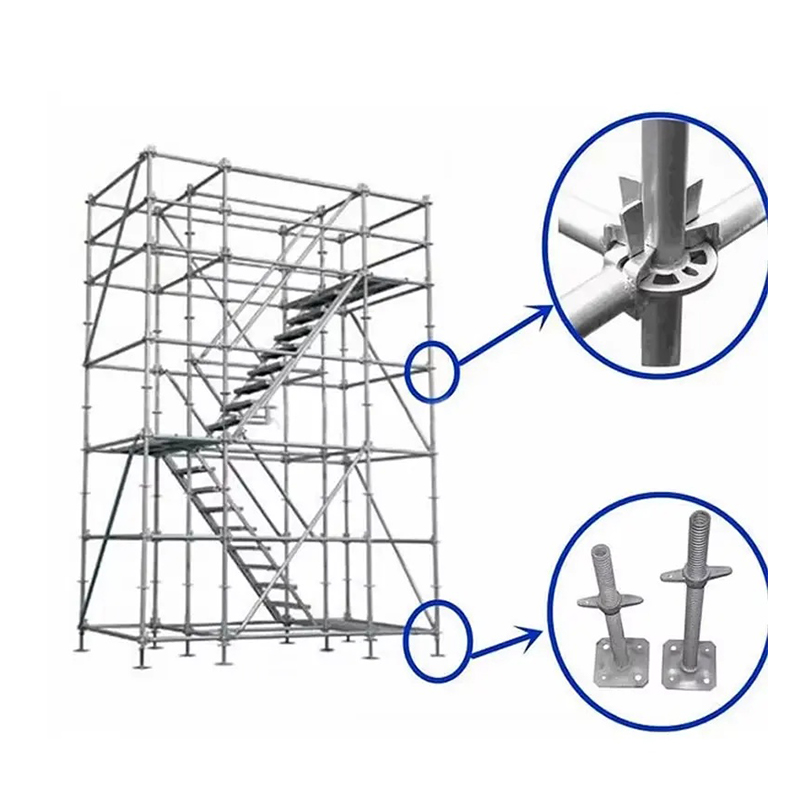
- Base jacks (adjustable base plates): Threaded steel screw assemblies fitted to the bottom of the standards, allowing the scaffold to be leveled on uneven ground. Extension beyond the maximum recommended protrusion length reduces the load capacity of the standard significantly.
Platform and Safety Components
- Scaffold planks / steel decking units: The working surface of the scaffold, spanning between transoms. Steel decking units with integrated non-slip surfaces are preferred over timber planks for durability and long-term reuse.
- Guardrails and toe boards: Mandatory fall prevention elements at open edges of working platforms. Top rail height is specified by the applicable safety standard for each country.
- Stair towers and ladder access units: Dedicated stair tower kits integrated into the scaffold system provide safe, ergonomic access between lift levels and are required by most modern construction safety regulations for scaffolds above a defined height.
- Couplers and sleeve connectors: Used in tube-and-coupler scaffold and as supplementary connection elements in modular scaffold to attach tie tubes, facade ties, and temporary bracing members to the main scaffold frame.
How to Choose the Right Scaffold Type for Your Project
Selecting the correct scaffold system is a decision that affects worker safety, project cost, program duration, and scaffold reusability across future projects. The following practical criteria guide the selection process.
Step 1: Define the Structure Geometry
If the structure being scaffolded is rectangular and regular in plan, frame scaffold or cuplock/kwikstage modular scaffold will provide the fastest erection at the lowest cost. If the structure has curved walls, multi-level setbacks, complex equipment, or a non-rectangular plan, ringlock modular scaffold or tube-and-coupler scaffold is the appropriate choice.
Step 2: Establish the Load Requirements
Scaffold working platforms are classified by the maximum load they are designed to carry per unit area. For access scaffolding with workers and hand tools only, a lighter system is adequate. For brick-laying, concrete block work, or storage of heavy materials on the scaffold, a higher-capacity system — ringlock or heavy-duty cuplock — is required. For shoring and falsework supporting cast-in-place concrete, the maximum load per leg is the governing criterion, and the W60 ringlock heavy-duty system or shoring frame system should be specified.
Step 3: Consider Erection Speed and Labor Availability
On projects where scaffold erection and dismantling are on the critical path, system scaffold is always preferred over tube and coupler. Kwikstage's tool-free assembly and five-component simplicity make it the fastest system for straightforward projects. Ringlock erection on complex structures is approximately 30% faster than equivalent cuplock erection due to the elimination of cup-jamming and the self-locating wedge connection. Where skilled scaffolders are scarce, simpler systems reduce the risk of assembly errors that compromise structural integrity.
Step 4: Assess Surface Treatment and Environment
In marine, coastal, or high-humidity environments, hot-dip galvanized scaffold components outperform painted steel by a significant margin and should be specified as the default. For projects where the scaffold is reused frequently across multiple sites, galvanized components maintain their corrosion protection through repeated assembly and disassembly cycles without the paint film degradation that affects less durable surface treatments.
Step 5: Evaluate Supplier Technical Support
For complex scaffold designs — high shoring towers, irregular industrial scaffold, or large-scale access scaffold for infrastructure projects — the supplier should provide engineering drawings, load calculations, and a qualified engineer's review of the design before erection begins. Suppliers with in-house engineering capability, ISO-certified quality management, and documented export experience are the appropriate choice for international procurement of scaffold materials.
Scaffold Safety Standards and Quality Certification
Scaffold materials must conform to applicable national and international standards to be accepted on regulated construction sites. Key standards governing scaffold component dimensions, material properties, load testing, and surface treatment include:
- EN 39 / EN 74: European standards for scaffold tubes and couplers, governing steel grade, tube wall thickness, dimensional tolerances, and mechanical testing requirements.
- AS/NZS 1576: The Australian and New Zealand scaffold standard series, which governs both scaffold design and the performance of Kwikstage and other modular scaffold components widely used in those markets.
- OSHA 1926 Subpart Q: The US federal standard governing scaffold construction, use, and inspection on construction sites, establishing load ratings, platform width requirements, and fall protection provisions.
- CE marking (Europe): Confirms that scaffold components placed on the EU market meet the structural and safety requirements of the applicable harmonized European standard.
- ISO 9001: Quality management system certification confirming that the scaffold manufacturer operates documented production controls, incoming material inspection, and final product testing — a baseline requirement for international procurement.
When sourcing scaffold materials internationally, buyers should request mill test reports for the steel used in component manufacture, copies of applicable product certifications, and evidence of third-party load testing of the proposed scaffold system. These documents are essential for satisfying site safety inspectors and building control authorities in most jurisdictions.


- Location
- Group 3, Fangzhuang Village, Rucheng Subdistrict, Rugao City, Nantong, Jiangsu, China
- Follow us
- Phone
- +86-13646196162
- info@hysonindustry.com
